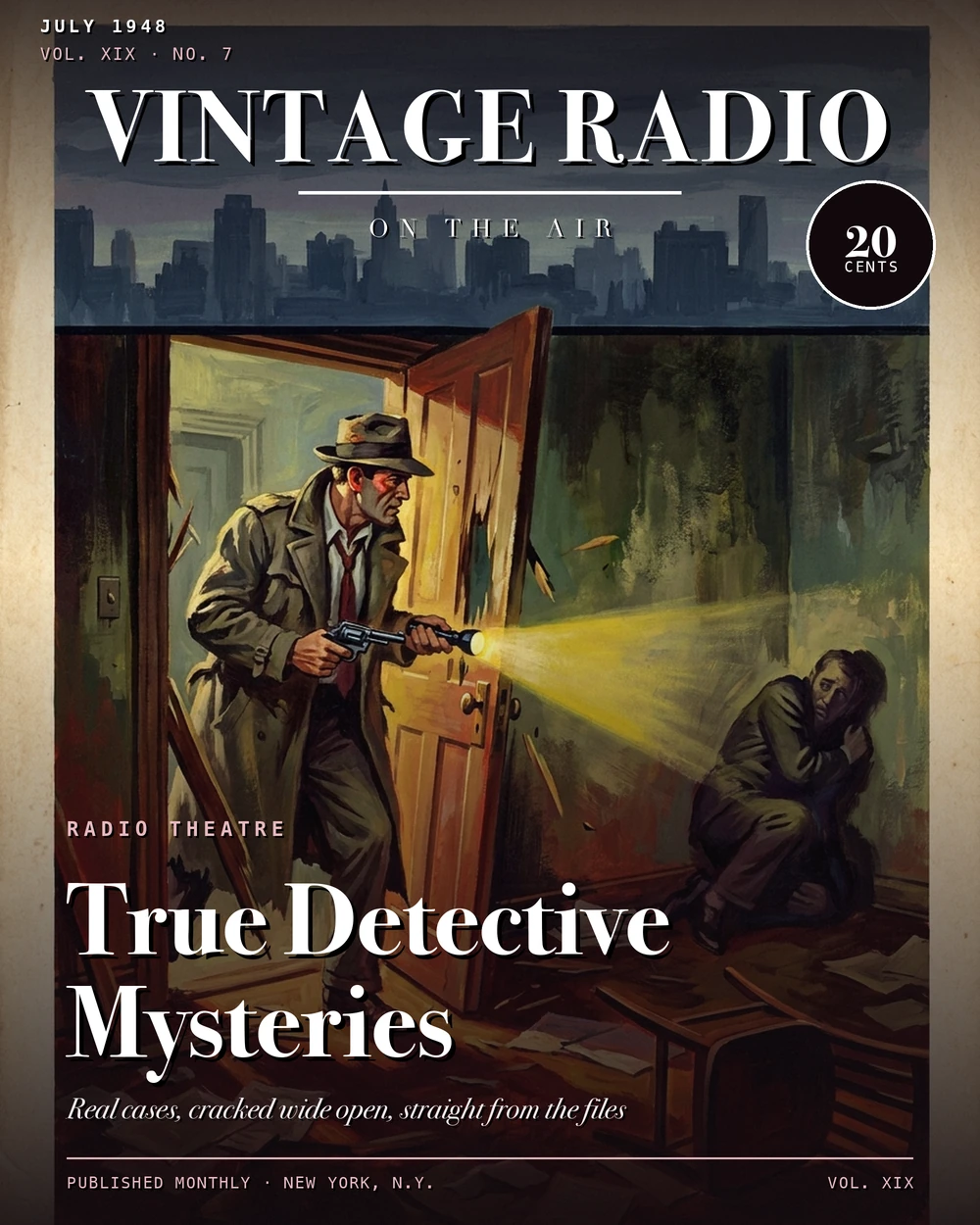
True Detective Mysteries
How a Magazine Became a Radio Institution
True Detective Mysteries had an unusual origin for a radio program — it began as an extension of a publication rather than a standalone broadcast concept. The source magazine, founded in 1924 by publisher Bernarr Macfadden as part of his Macfadden Publications empire, is widely considered the first true crime magazine. It started with a mix of mystery fiction and non-fiction crime stories, but through the 1930s Macfadden phased out the fiction entirely, and by 1941 had renamed the publication simply True Detective to reflect that shift. At the height of its popularity the magazine was selling approximately two million copies a month, and it published early work by writers including Dashiell Hammett, Jim Thompson, and Ann Rule.
The radio program launched on CBS on May 16, 1929, with director Charles Schenck — described in contemporary accounts as "one of radio's pioneers in stagecraft" — at the helm. In those early CBS years, roughly the same cast dramatized stories drawn from the current issue of the magazine each week. The production style was notable for its commitment to physical realism: when a script called for a struggle, the actors actually struggled in the studio; when police car sirens appeared in the scene, live sirens and gongs were produced on the spot. All the sound effects — pistol shots, slamming doors, crashing glass, speeding autos — came from a single specialist who worked from his own copy of the script and followed cues at his own microphone. The CBS run wrapped in May 1930, and the show spent several years off network air before returning.
The Format That Defined the Show
The version of True Detective Mysteries most listeners remember came from its long Mutual network run, which stretched from April 1944 all the way to June 2, 1958. This was an anthology Crime-Detective program presenting what it called "a case history of an actual crime" each week. The cases weren't always recent — some were more than twenty years old at the time of broadcast — but all were framed to prove that crime doesn't pay. In this sense the show resembled Gang Busters, following criminals through their fatal errors and watching their inevitable capture.
What set it apart from straightforward dramatization was the active law-enforcement element that followed each episode. After the story ended, the show read out detailed clues about real fugitives — descriptions focused heavily on identifying physical features like scars and deformities. These clue segments led to many actual arrests when listeners called in tips. True Detective magazine had already experimented with this participatory approach in 1931 through a feature called "Line Up," which published mug shots and descriptions of fugitives submitted by police departments around the country. The radio program carried that same spirit into the broadcast medium. The magazine also offered rewards — starting at $500 and later raised to $1,000 — for information leading to real arrests, with those offers tied to the show's broadcasts.
Despite its title, the program wasn't really structured as mysteries in the traditional sense. Many stories unfolded from the criminal's point of view rather than following an investigator solving a puzzle. The audience watched things go wrong for the perpetrator rather than worked alongside a detective. That narrative choice gave the show its particular texture — less whodunit, more Greek tragedy in a crime setting.
The People Behind It
The on-air host for much of the run was Richard Keith, who played John Shuttleworth, presented as editor-in-chief of True Detective magazine. In a later era, John Griggs took over, playing an unnamed "editor" in the same framing role. Hugh James and Ralph Paul served as announcers, and organist Paul Taubman provided the music throughout. The writers-directors who shaped the show's scripts were Murray Burnett in the 1940s and Peter Irving in the later period.
Burnett is a figure worth noting on his own terms. Born in New York City in 1910, a Cornell graduate who spent time teaching high school English, he co-wrote an unproduced play called Everybody Comes to Rick's with Joan Alison in 1940. Warner Bros. bought it for $20,000, and it became the 1942 film Casablanca. The song "As Time Goes By" was already in Burnett and Alison's original play — it had been Burnett's favorite since his Cornell days — and that's how it ended up in the film. After Casablanca's enormous success, Burnett received little formal recognition, and he and Alison unsuccessfully sued Warner Bros. for $6.5 million, arguing their play had provided the heart of the picture. He continued writing for radio and also penned the 1944 Broadway play Hickory Street, drawn from his teaching years. Beyond True Detective Mysteries, he is credited on the early television crime drama Photocrime on ABC in 1949 and on the soap opera Guiding Light.
Taubman's career had its own trajectory. Born in Winnipeg in 1911, he became a fixture in New York as an organist, eventually owning a nightclub called the Penthouse Club overlooking Central Park, where he performed nightly before selling it and moving into production music. After his radio work he provided background music for television quiz shows including Tic Tac Dough, Dough-Re-Me, and Concentration, and served as music director for Twenty-One, the rigging scandal of which was dramatized in the 1994 film Quiz Show. He also worked with Bob and Ray on their NBC radio transcriptions in the early 1950s and played on the TV soap opera The Edge of Night.
Sponsors, Schedules, and One Very Memorable Commercial
The show's sponsorship history stretched across several different companies over the decades. The first Mutual return, from September 1936 through August 1937, was sponsored by True Detective magazine itself — one of the few periods when the publication and the program were directly linked commercially. Listerine sponsored the 1938–39 Mutual run. From 1946 to 1953 the sponsor was Oh Henry Candy, and that era produced one of the show's most remembered pieces of audio: a telephone-ring sketch in which a woman says "Oh Henry?" and a man responds, "Hold the phone! Hold the phone! It's time for Oh Henry, public energy number one!" The announcer's framing of those transcribed episodes also made explicit that the show was pre-recorded rather than live — an acknowledgment that became part of the program's signature during that stretch.
The Mutual run of 1944–58 shifted time slots numerous times over its fourteen years. The show aired Saturday nights at 10:15 in its initial 1944 months, moved to Sunday afternoons at 1:30 for 1944–45, then to 4:30 on Sundays for 1945–49, to 5:30 on Sundays for 1949–55, and finally to Monday evenings at 8 for its last three years. These shifts reflect the typical drift of a long-running network program as it negotiated with affiliate demands and changing listener habits over more than a decade.
How It Ended and What Survives
When True Detective Mysteries concluded its final broadcast on June 2, 1958, it was among the last Mutual network radio dramas still on the schedule. The medium had been contracting around it for years, and the show's end came as network radio drama broadly gave way to television. The format it had developed — real cases, audience participation through tip lines, rewards for information leading to arrests — anticipated in recognizable ways the structure of later true crime broadcasting and programs like Unsolved Mysteries.
What has survived represents a fraction of the full run. Roughly eighteen recordings totaling about seven and a half hours are known to exist, including several 1937 broadcasts from the first Mutual period — episodes with titles like "Rattlesnake Barefoot Bride," "Horror In The Hospital Ward," "The Black Legion," "Buddha Man Mystery," and "Girl In The Iron Mask" — alongside later episodes from 1957 and 1958 such as "The Body In The Road," "Mary Ann Webster Kidnapped," "Nellie Lippert Case," and "Hitchhiking Psycho." The late-1930s transcription discs were recorded off in the 1970s and later digitized. The surviving episodes offer a cross-section of the show's long life, though they represent only scattered samples of what aired across nearly three decades of broadcasting.